
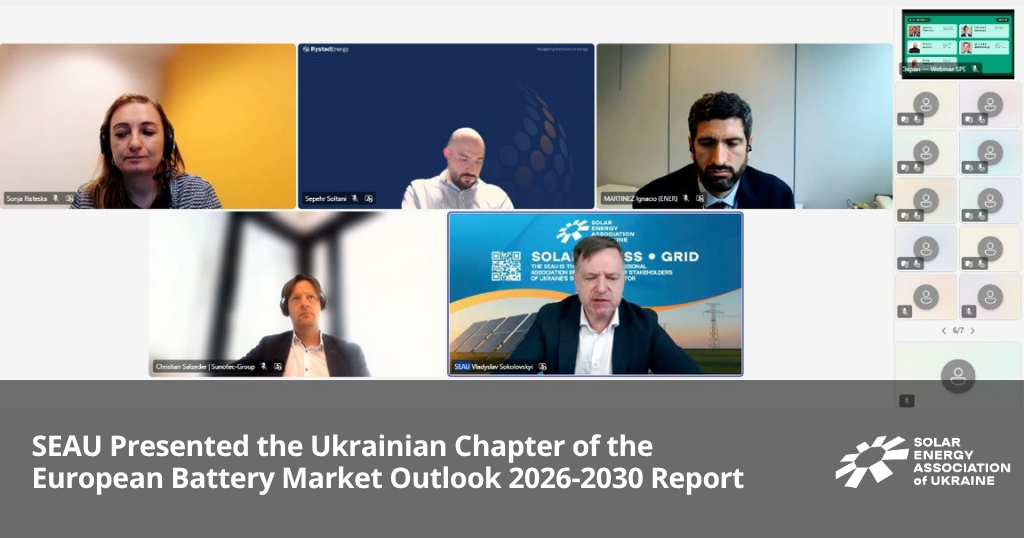
On 30 June 2026, Vladyslav Sokolovskyi, Chairman of the Board of the Solar Energy Association of Ukraine, participated as a speaker in the webinar launching SolarPower Europe’s analytical report, European Battery Market Outlook 2026-2030, for international experts, investors, and business representatives.
More than 430 participants joined the webinar, during which SolarPower Europe presented its new analytical report, “European Battery Market Outlook 2026–2030,” dedicated to the development of the European battery energy storage market through 2030.
The Solar Energy Association of Ukraine (SEAU) played an active role in preparing the Ukraine chapter of the report. Over the course of two and a half months, SEAU experts compiled comprehensive research and provided up-to-date analysis of the development of Ukraine’s battery energy storage market.
The report presents the latest data on installed BESS capacity across European countries as of 2025, market forecasts through 2030 under several scenarios, analyses of the residential, commercial, and industrial segments, as well as policy recommendations aimed at accelerating the deployment of energy storage technologies.
During the event, SolarPower Europe experts presented the report, followed by an international expert panel featuring representatives of industry associations, project developers, public authorities, and the energy sector. The discussion focused on the development of the European BESS market, regulatory trends, and the future deployment of battery energy storage systems across Europe.
As a panel speaker, Vladyslav Sokolovskyi presented an overview of the current state of Ukraine’s BESS market and its key development trends.
According to SEAU estimates, more than 1 GWh of new battery energy storage capacity was commissioned in Ukraine across all market segments during 2025. This includes electrochemical energy storage systems operating in energy arbitrage and ancillary services markets, as well as systems installed by businesses, social and critical infrastructure facilities, and households to enhance energy security and self-consumption.
Particular attention was given to the rapid development of the industrial-scale BESS segment. In 2025, Ukraine commissioned 500 MW / 1,000 MWh of utility-scale battery energy storage systems. The flagship project was implemented by DTEK Renewables and Fluence, comprising six sites with a combined capacity of 200 MW / 400 MWh.
The presentation also highlighted the rapid growth of distributed energy storage. According to SEAU estimates, at least one in five apartments in Kyiv is already equipped with a battery system, while 80–100% of critical infrastructure facilities that have installed solar power systems are also equipped with battery energy storage systems.
A separate section of the presentation focused on legislative developments supporting further market growth. Participants were introduced to the new Feed-in Premium mechanism, which replaced Contracts for Difference (CfDs), as well as the introduction of a dedicated auction quota for Solar + BESS projects under Ukraine’s renewable energy support scheme.
“Today, Ukraine has become a unique testing ground where energy storage technologies are being deployed under the most challenging conditions imaginable. The experience we are gaining – how to rapidly build projects, integrate BESS during wartime, and maintain grid balancing under continuous attacks – is valuable for the whole of Europe. We are ready to share this expertise with our international partners,” said Vladyslav Sokolovskyi, Chairman of the Board of SEAU.
The Solar Energy Association of Ukraine expresses its sincere gratitude to SolarPower Europe for the invitation to participate in the launch of the report and for the opportunity to present Ukraine’s experience in battery energy storage development to the international community.
Despite the ongoing war, Ukraine’s BESS market continues to develop rapidly, while the practical solutions being implemented today are increasingly shaping new approaches to strengthening energy resilience not only in Ukraine but across Europe.