
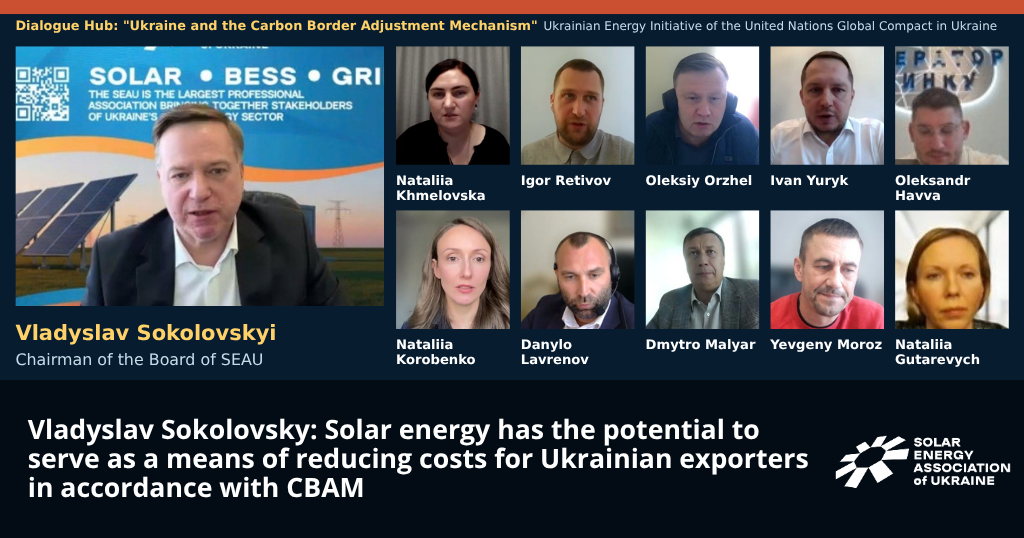
Vladyslav Sokolovskyi, Chairman of the Solar Energy Association of Ukraine (SEAU), spoke at the Dialogue Hub about practical opportunities to use the low-carbon footprint of solar generation to reduce Ukrainian exporters’ costs under the CBAM mechanism, as well as the necessary regulatory solutions and challenges related to the verification of electricity from solar PV plants and energy storage systems.
On 29 September 2026, the online Dialogue Hub “Ukraine and CBAM: Impact on Energy, Electricity Exports and Integration into the EU Market” took place. The event was organized by the UN Global Compact Network Ukraine’s Ukrainian Energy Initiative.
Participants discussed the impact of the Carbon Border Adjustment Mechanism (CBAM) on Ukraine’s energy sector, the competitiveness of Ukrainian electricity on the EU market, generation decarbonization, cross-border electricity trade, and Ukraine’s further integration into the European energy market.
Representatives of government authorities, energy companies, market operators, and industry associations took part in the discussion.
SEAU was represented by its Chairman, Vladyslav Sokolovskyi, who spoke in the session “The Position of Industry Associations: What CBAM Means for Different Energy and Business Segments.”
In his presentation, Vladyslav Sokolovskyi focused on practical opportunities to use the low-carbon footprint of solar generation to reduce Ukrainian exporters’ costs under CBAM.
According to the SEAU Chairman, CBAM came into operation on 1 January 2026, while the sale of CBAM certificates will begin in 2027, with the obligations already applying to supplies made this year. Legally, CBAM is a financial mechanism rather than a taxation regime. It is implemented by the declarant in the EU, while the economic costs may be passed on to Ukrainian sellers through contractual pricing conditions.
According to Vladyslav Sokolovskyi, a key issue for Ukrainian businesses is demonstrating the low emissions of a specific shipment in accordance with EU rules.
“The key point is to demonstrate the low emissions of a specific shipment in accordance with EU rules,” said Vladyslav Sokolovskyi.
He outlined several practical models through which solar generation could contribute to reducing the carbon intensity of products exported by Ukrainian companies.
Corporate physical PPA. For industries such as cement and fertiliser production, the electricity component is included in emissions calculations. A direct physical electricity supply agreement with a specific solar power plant may allow a lower actual emissions factor to be applied. At the same time, this approach requires hourly data, allocation profiles and appropriate verification.
An exporter’s own solar power plant. Another option is to install a solar PV plant directly on the company’s premises with a direct technical connection to the production facility. This model can facilitate the verification of actual emissions factors, but also requires hourly metering of electricity consumption from the solar plant and the grid, proper allocation between production processes, and verification.
Electricity exports to the EU. Another area is the use of Ukraine’s low-carbon electricity for exports. According to Vladyslav Sokolovskyi, solar generation accounts for approximately 90–95% of the electricity mix handled by the Guaranteed Buyer. At the same time, for utility-scale solar plants, an important issue remains the future business model after the green tariff expires in 2030.
During his presentation, Vladyslav Sokolovskyi also highlighted a new practical challenge — the verification of electricity generated by solar PV plants combined with energy storage systems.
It is necessary to clearly distinguish electricity charged into an energy storage system from the solar power plant from electricity supplied from the grid. This may require separate technical meters and clear rules for verifying the origin of the electricity.
The issue is becoming increasingly important given the rapid development of combined projects: according to the SEAU Chairman, around 80% of new solar power plants are being built with energy storage systems.
During the discussion, the SEAU expert outlined several issues requiring further consideration, including:
- using Guarantees of Origin to offset the domestic carbon tax, which, in SEAU’s view, could also contribute to increasing the value of Guarantees of Origin;
- obtaining official guidance on the methodology for verifying electricity from energy storage systems, including confirmation that the electricity charged into the system originated specifically from solar generation;
- recognition of Ukrainian Guarantees of Origin in the EU — a step that, while not directly solving the CBAM issue, could support mechanisms for verifying the use of renewable energy;
- conducting legal and economic assessments of pilot supplies to practically verify the possibility of reducing CBAM costs through the use of electricity from specific solar power plants.
There are currently no practical examples of such supplies on the Ukrainian market. Therefore, SEAU considers it important to move from theoretical mechanisms towards the implementation of pilot projects.
The issue of Guarantees of Origin was also discussed during the event. As Vladyslav Sokolovskyi stressed, Guarantees of Origin themselves are not CBAM certificates and do not directly reduce the amount payable under the mechanism. They confirm the renewable energy attribute.
At the same time, Mr Sokolovskyi emphasised the importance of improving the mechanisms for using Guarantees of Origin and integrating them into a broader system of incentives for the decarbonisation of Ukraine’s economy.
According to the SEAU Chairman, the potential recognition of Ukrainian Guarantees of Origin in the EU, combined with other regulatory solutions, could become one element of a comprehensive approach to reducing the carbon intensity of Ukrainian products.
Solar energy as part of Ukraine’s competitiveness strategy
Participants of the Dialogue Hub also discussed the role of the government and business in maintaining the competitiveness of Ukrainian electricity on the EU market, the need to decarbonise generation, and prospects for further integration of Ukraine’s energy market with the European market.
For SEAU, it is important that the development of solar generation is viewed not only as a tool for transforming the energy system, but also as a practical factor in the competitiveness of Ukrainian products on European markets.
“Solar energy can help exporters reduce their CBAM costs while simultaneously supporting our energy system,” concluded Vladyslav Sokolovskyi.
SEAU thanks the UN Global Compact Network Ukraine’s Ukrainian Energy Initiative for organising the Dialogue Hub and all participants for the substantive and practical discussion on the future of Ukraine’s energy sector, decarbonisation, and Ukraine’s integration into the European energy market.