
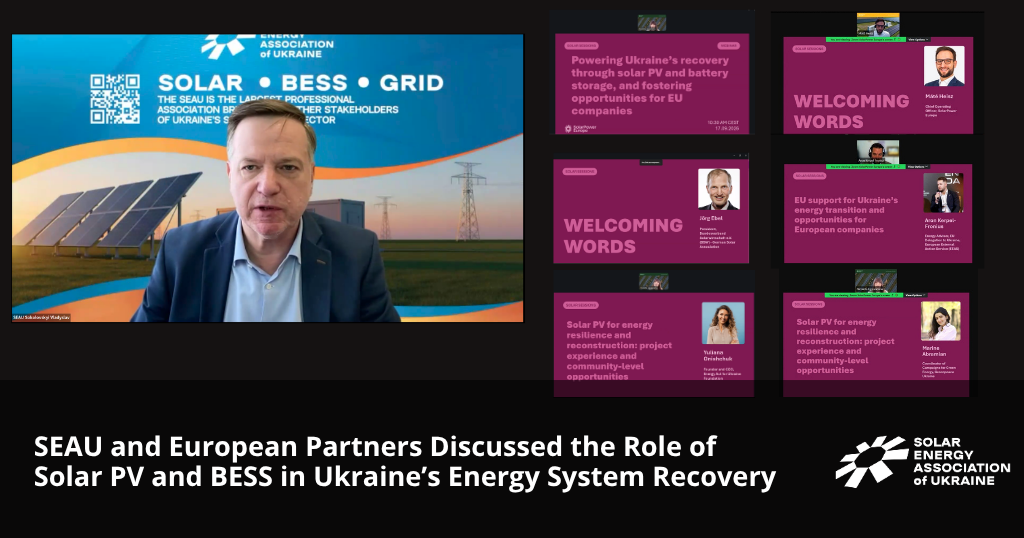
On 17 September 2026, Vladyslav Sokolovskyi, Chairman of the Solar Energy Association of Ukraine (SEAU), spoke at the international SolarPower Europe webinar “Powering Ukraine’s recovery through solar PV and battery storage, and fostering opportunities for EU companies”, dedicated to the role of solar energy and energy storage systems in Ukraine’s recovery.
The event focused on the development prospects of Ukraine’s solar generation and battery energy storage systems (BESS) market, the needs of the Ukrainian energy system, the regulatory environment, investment opportunities, and prospects for deepening cooperation between Ukraine and European businesses. As the organisers noted, solar generation combined with BESS is considered one of the strategic directions for strengthening Ukraine’s energy independence and resilience, as well as an important element of the country’s recovery.
The webinar brought together representatives of SolarPower Europe, the German Solar Association (BSW), Ukraine’s energy sector, the European External Action Service (EEAS), and civil society. The event was moderated by Nicoleta Lipcaneanu, Project Manager at SolarPower Europe.
The webinar was opened by Máté Heisz, Chief Operating Officer at SolarPower Europe, and Jörg Ebel, Vice President of Corporate Affairs at IBC Solar and President of the German Solar Association (BSW). In their opening remarks, they outlined the role of solar energy and energy storage systems in supporting Ukraine’s energy transition and recovery.
Vladyslav Sokolovskyi presented participants with an overview of the current state of Ukraine’s solar generation and BESS market, its needs, challenges, and investment opportunities.
In his presentation, the SEAU Chairman highlighted the large-scale challenges facing Ukraine’s energy system. According to SEAU estimates, since the beginning of the full-scale war, up to 50% of Ukraine’s generation capacity – more than 27 GW – has been destroyed, lost, or damaged. Around 10 GW of new and restored generation capacity is needed to rebuild the energy system.
At the same time, Ukraine’s solar energy market continues to develop rapidly. As of mid-2026, the total installed solar generation capacity, including utility-scale facilities and systems for the self-consumption of businesses and households, is estimated at 9.4-9.7 GW. During the first half of 2026, up to 1.1 GW of new solar capacity was commissioned, with around 80% of new installations having a capacity of up to 1 MW and being primarily intended for self-consumption.
Vladyslav Sokolovskyi also paid particular attention to the development of BESS. In Ukraine, energy storage systems are currently being installed primarily as a tool for ensuring energy resilience and backup power supply. At the same time, the market is gradually opening up opportunities for new monetisation models, including ancillary services and price arbitrage. More than 80% of facilities that have installed solar power plants have also added energy storage systems.
Ukraine has already become one of the largest BESS markets in Europe. In 2025, around 2.9 GWh of new energy storage systems were installed, placing Ukraine fourth in Europe in terms of new BESS installations across all segments. The preliminary estimate for the first half of 2026 stands at 1.6–1.9 GWh.
“For Ukraine, solar generation combined with BESS is no longer just a matter of transitioning to clean energy. It is a practical tool for increasing the resilience of the energy system, enabling the rapid deployment of distributed generation capacity and ensuring electricity supply to consumers amid persistent risks to centralised generation,” said Vladyslav Sokolovskyi.
Among the priorities for the development of the sector in the second half of 2026 and in 2027, the SEAU Chairman highlighted the rapid restoration and protection of energy infrastructure, continued support for distributed generation, the creation of effective mechanisms to mitigate war-related risks for investors, simplified grid connection procedures for new energy facilities, integration of Ukraine’s electricity market with the EU market, access to concessional financing, and the development of microgrids based on solar generation and BESS.
“The next stage of Ukraine’s energy sector development should be based on the rapid deployment of distributed generation, energy storage systems, and microgrids. To achieve this, Ukraine needs clear grid connection rules, accessible financing, mechanisms to mitigate war-related risks, and deeper integration with the European energy market. These conditions can open up new opportunities for Ukrainian and European investors,” emphasised the SEAU Chairman.
Particular attention during the webinar was also paid to the European Union’s support for Ukraine’s energy transition and opportunities for European companies. This topic was addressed by Aron Kerpel-Fronius, Energy Advisor at the EU Delegation to Ukraine, European External Action Service (EEAS). This part of the programme focused, in particular, on opportunities for European businesses to engage in the development of Ukraine’s energy sector.
Yuliana Onishchuk, CEO of Energy Act for Ukraine Foundation, presented Ukraine’s solar energy market from the perspective of investment opportunities, the realities faced by investors, and current market dynamics.
The practical dimension of using solar generation to enhance energy resilience and support recovery was presented by Marine Abramian, Green Energy Campaign Coordinator at Greenpeace Ukraine. Her presentation focused on practical experience in implementing solar energy projects and opportunities for developing projects at the community level.
The webinar concluded with a Q&A session, during which participants discussed current issues related to the development of solar generation and energy storage in Ukraine, as well as prospects for further Ukrainian-European cooperation.
Overall, the event brought together representatives of European and Ukrainian energy organisations, institutions, and civil society to discuss how solar generation and BESS can contribute to Ukraine’s energy resilience and recovery while creating new opportunities for European companies.
For reference: Representatives of the Solar Energy Association of Ukraine – SEAU Chairman Vladyslav Sokolovskyi, Head of the SEAU Legal Committee Ivan Balytsky, and Head of the SEAU Investment Committee Dmitro Lukomskyi – participated in the preparation of the Ukrainian sections of the solar energy and BESS sector research conducted by SolarPower Europe. For more than 2.5 months, SEAU experts collected and analysed data on Ukraine’s solar energy and energy storage sectors. The collected materials and analytical work were used in the European Battery Market Outlook 2026–2030 and Global Solar Market Outlook 2026–2030 reports.