
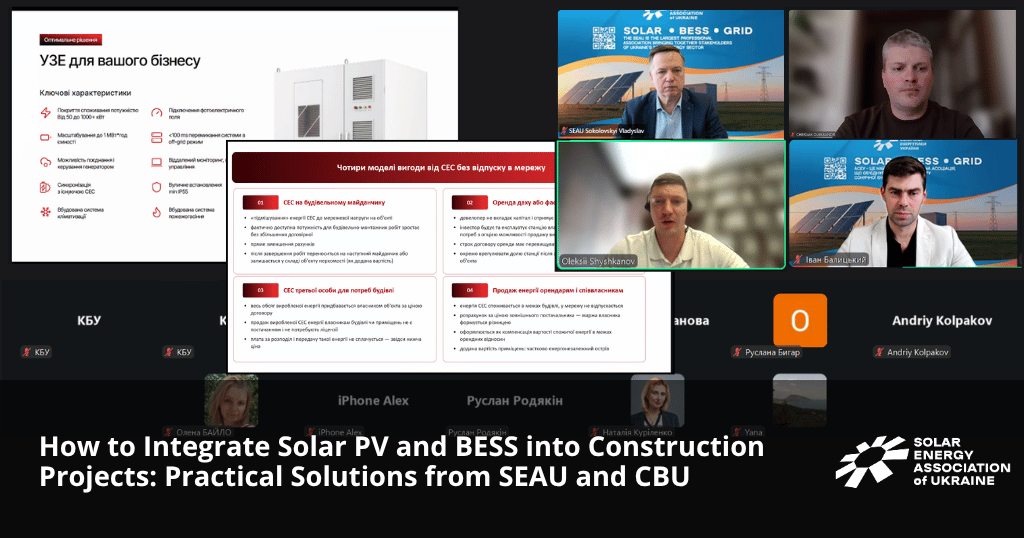
On September 8, 2026, the Solar Energy Association of Ukraine (SEAU) and the Confederation of Builders of Ukraine (CBU) held a joint webinar titled “Solar Power Plants as a Tool for Energy Independence in Construction Projects: Technical Aspects of Solar PV Installation.”
The main focus of the meeting was the practical integration of solar generation and energy storage systems into residential, commercial, and industrial facilities. Participants gained a comprehensive overview – from legal models for using solar PV to technical configurations and real-world implementation examples.
The participants were welcomed by SEAU Chairman Vladyslav Sokolovskyi and CBU CEO Oleksandr Chervak. As highlighted during the event, solar generation is increasingly becoming not only a tool for strengthening energy resilience in the construction sector, but also an element of the economics and competitiveness of modern buildings and facilities.
Ivan Balytsky, Head of the SEAU Legal Committee, presented the legal mechanisms for using solar generation.
He emphasized that for construction businesses, solar PV is not simply a matter of installing equipment, but also of choosing an appropriate legal and economic model that determines how the facility will use the electricity it generates.
Participants reviewed the mechanisms of self-consumption, self-generation (net billing), electricity sales on the wholesale market, and participation in green auctions, as well as options for involving third parties in the installation and operation of solar PV systems.
Ivan Balytsky also presented four practical models for using solar PV without feeding electricity into the grid: installing a system directly at a construction site; leasing a roof or façade to an investor; using a third-party solar PV system to meet the building’s energy needs; and models in which solar generation is used by tenants or co-owners of a facility. Such solutions can allow developers to reduce their own energy costs or gain additional economic benefits without having to invest directly in the construction of a solar power plant.
An important practical issue was the assessment of the load-bearing capacity of roofs and façades. As noted during the webinar, even where separate construction permits are not required, assessing the technical condition of the structures remains essential for safe solar PV installation. In particular, the assessment report should take into account the impact of the solar installation on the strength, stability, and rigidity of the building structures.
Particular attention was also paid to the use of electric vehicle charging stations as an additional element of a facility’s energy infrastructure. Under an appropriate business model, EV charging is considered electricity consumption, which can generate additional revenue for a developer while also making use of the daytime generation profile of a solar PV system.
The technical part of the webinar was delivered by Oleksii Shyshkanov, Head of Alternative Energy at Dolya Solar Energy. He focused on the practical aspects of solar PV design and installation, as well as opportunities to combine solar generation with energy storage systems.
Key issues included determining the optimal system capacity based on the facility’s consumption profile, integrating solar PV into the facility’s internal electrical network, the specifics of connection to external grids, and opportunities to incorporate solar generation into new construction projects as an additional competitive advantage.
Participants also examined energy storage systems, which can operate in combination with solar PV, provide backup power, improve the efficiency of electricity use, and reduce the operating costs of generators. The solutions discussed included On-Grid, Backup, Microgrid, as well as AC and DC coupling.
The practical part of the webinar was complemented by real-world cases of energy solutions implemented by Dolya Solar Energy for commercial and residential facilities.
In particular, examples were presented of solar PV systems combined with energy storage and backup power sources for office buildings and residential complexes. Such solutions can provide backup power for critical loads, increase the autonomy of facilities during outages, and enable more efficient use of on-site solar generation.
The implemented solutions included scalable energy storage systems for office facilities that can operate together with solar PV and generators, as well as an energy infrastructure solution for a residential complex where solar PV is used for on-site generation and energy storage systems enhance the reliability of electricity supply.
The webinar also demonstrated that the configuration of an energy system should be tailored to the specific use case of each facility – including its consumption profile, required level of backup, load capacity, and energy independence objectives. At the same time, systems can be scaled and expanded with additional components, including solar PV, energy storage systems, and generators.
The discussion emphasized that combining solar PV, energy storage systems and, where necessary, a generator can create more flexible energy supply models for construction and commercial facilities. At the same time, the technical solution must take into account the facility’s consumption profile, capacity, and the economics of the specific project.
Participants also had the opportunity to ask questions and discuss the issues with the speakers. Given the strong interest in the topic, the possibility of holding further events dedicated to energy storage systems, their integration with different generation technologies, and grid connection requirements was also discussed.
SEAU thanks the Confederation of Builders of Ukraine, the speakers, and all webinar participants for the substantive discussion and their interest in developing modern energy solutions for the construction sector.