
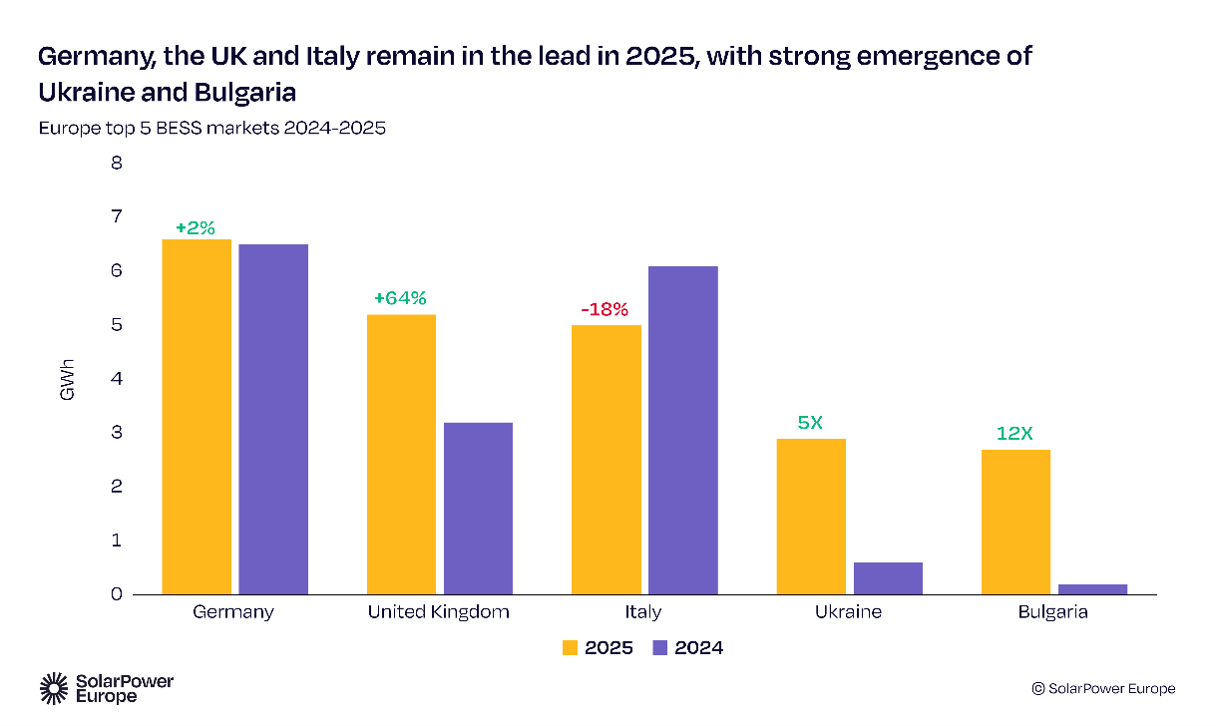
Ukraine ranked fourth among Europe’s largest energy storage markets, installing almost 3 GWh of battery energy storage systems (BESS) in 2025 – five times more than in 2024.
These figures are presented in a SolarPower Europe press release dated 20 August 2026, dedicated to the launch of the European Battery Market Outlook 2026–2030. The Solar Energy Association of Ukraine (SEAU) actively contributed to the preparation of the Ukrainian chapter of the report.
Only Germany, the United Kingdom and Italy installed more new BESS capacity in 2025. Ukraine outpaced a number of other European markets, including Bulgaria, entering the top five largest energy storage markets in Europe.
One of the key characteristics of the Ukrainian market is the significant share of the distributed segment. More than 60% of the new capacity installed in 2025 consisted of energy storage systems for households, businesses, schools, hospitals, water supply facilities and other critical infrastructure.
At the same time, almost one-third of the new capacity came from utility-scale BESS projects, which provide essential flexibility to the power system and deliver balancing services.
As Vladyslav Sokolovskyi, Chairman of the Board of SEAU, noted, Ukraine’s energy storage market has its own specific characteristics, primarily driven by the need for energy security and resilience:
“Ukraine is proving that batteries are more than just an energy technology – they are a technology of resilience. Our market is also structurally different from the rest of Europe, and this difference lies precisely in the distributed segment.”
According to the expert, in Europe, residential energy storage systems are primarily used to optimise energy costs and store electricity generated by rooftop solar PV systems. In Ukraine, however, a significant share of such systems is installed primarily to ensure electricity supply during power outages.
Apartment residents and private homeowners install small-scale systems with an average capacity of 3-5 kWh, with many of them not connected to solar PV systems at all. A significant part of the residential segment is also made up of portable power stations with capacities of 0.6-2.5 kWh, which are used to provide backup power.
Small and medium-sized businesses, in turn, install larger systems primarily to strengthen their energy security. At the same time, utility-scale BESS are already operating in the ancillary services market and are being used for energy arbitrage.
SolarPower Europe also highlights the rapid development of the Ukrainian market against the backdrop of the need to strengthen the resilience of the power system.
Sonja Risteska, Head of SolarPower Europe’s Battery Storage Europe Platform, emphasised that Ukraine’s experience demonstrates the strategic importance of solar energy and energy storage systems for energy security:
“Ukraine’s experience demonstrates that batteries are an important tool for ensuring energy security and power system resilience.”
According to Vladyslav Sokolovskyi, as Ukraine moves forward with its recovery, energy storage systems will play a critical role in shaping a secure, flexible and sustainable energy future for the country.
In 2025, the European energy storage market added 36 GWh of new installed capacity, marking the twelfth consecutive year of record growth.
Europe’s total operational energy storage capacity exceeded 100 GWh for the first time, while annual new installations increased by 48% year-on-year. Utility-scale projects are playing an increasingly important role in this growth.
For reference: The Solar Energy Association of Ukraine actively contributed to the preparation of the Ukrainian chapter of the European Battery Market Outlook 2026–2030.
Over the course of 2.5 months, SEAU experts worked on the study, preparing up-to-date analysis of the development of Ukraine’s energy storage market.
Read the press release
Read the report