
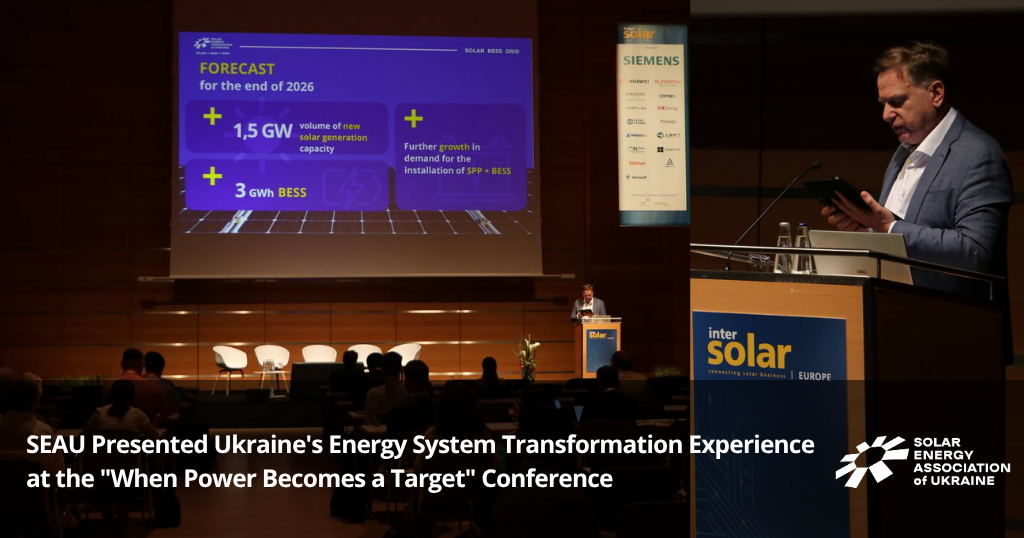
Vladyslav Sokolovskyi, Chairman of the Board of the Solar Energy Association of Ukraine, spoke at the international conference “When Power Becomes a Target – Building Resilient European Energy Systems Through Solar, Storage and Grid-Forming Technologies”.
The conference took place on 23 June as part of Intersolar Europe 2026 in Munich, Germany. The event brought together leading European experts, representatives of SolarPower Europe, BSW – German Solar Association, Rystad Energy, and national industry associations to discuss the future architecture of Europe’s energy security, as well as the role of solar generation, battery energy storage systems (BESS), and Grid-Forming technologies in strengthening the resilience of energy systems.
During his presentation, Vladyslav Sokolovskyi introduced the international audience to the current state of Ukraine’s solar energy and battery storage market and shared practical experience of transforming Ukraine’s power system under the conditions of a full-scale war.
According to Mr. Sokolovskyi, Ukraine is currently addressing two strategic objectives simultaneously: rebuilding its damaged energy infrastructure while constructing a new, more flexible and resilient power system based on the principles of distributed generation.
A significant part of the presentation focused on the development of the Solar + BESS market. Mr. Sokolovskyi emphasized that in Ukraine, solar generation combined with battery energy storage has long evolved beyond being merely a decarbonization tool. Today, it has become one of the key pillars of energy security for businesses, local communities, critical infrastructure, and households.
The presentation also featured SEAU’s latest market analytics. In particular, more than 1.5 GW of new solar PV capacity and over 1 GWh of verified battery energy storage capacity were commissioned in Ukraine during 2025.
At the same time, SEAU noted that the actual size of the market is significantly larger, as a substantial share of commercial and residential Solar + BESS systems operating exclusively for self-consumption is not reflected in official statistics. According to the Association’s market estimates, the real installed capacity of battery energy storage systems in 2025 is considerably higher due to the rapid expansion of the behind-the-meter segment.
A separate part of the presentation was dedicated to practical examples of using Solar + BESS to ensure the uninterrupted operation of critical infrastructure. Mr. Sokolovskyi presented successful projects implemented by Ukrainian municipal utilities that have established energy islands combining solar generation and battery storage systems to provide continuous water supply and district heating services, even during prolonged power outages.
The Chairman of SEAU also outlined the key priorities for the further development of Ukraine’s energy sector, including accelerating the restoration of damaged energy facilities, expanding distributed generation and battery energy storage, and creating a predictable regulatory framework to attract investment.
“Today, Solar + BESS in Ukraine is no longer simply an advanced technology. It has become one of the fundamental pillars of the country’s energy resilience. Ukraine is not rebuilding its pre-war energy system – we are creating a new architecture: more decentralized, more flexible, and more resilient to physical attacks and generation shortages”, said Vladyslav Sokolovskyi.
SEAU believes that Ukraine’s experience in developing solar energy and battery energy storage systems under wartime conditions already represents significant practical value for European partners. Therefore, the participation of Ukrainian experts in international professional discussions not only contributes to Ukraine’s integration into the European energy market but also helps shape new approaches to strengthening energy security and resilience across Europe.