
Ukraine’s solar energy and battery energy storage market continues to evolve rapidly. Alongside the emergence of new business models, technologies, and financing instruments, the expectations of international investors toward new projects are also changing.
What defines a project’s investment attractiveness today? Why is high-quality project development becoming a distinct professional competency? What role will investment-ready projects play in the further development of Ukraine’s renewable energy sector?
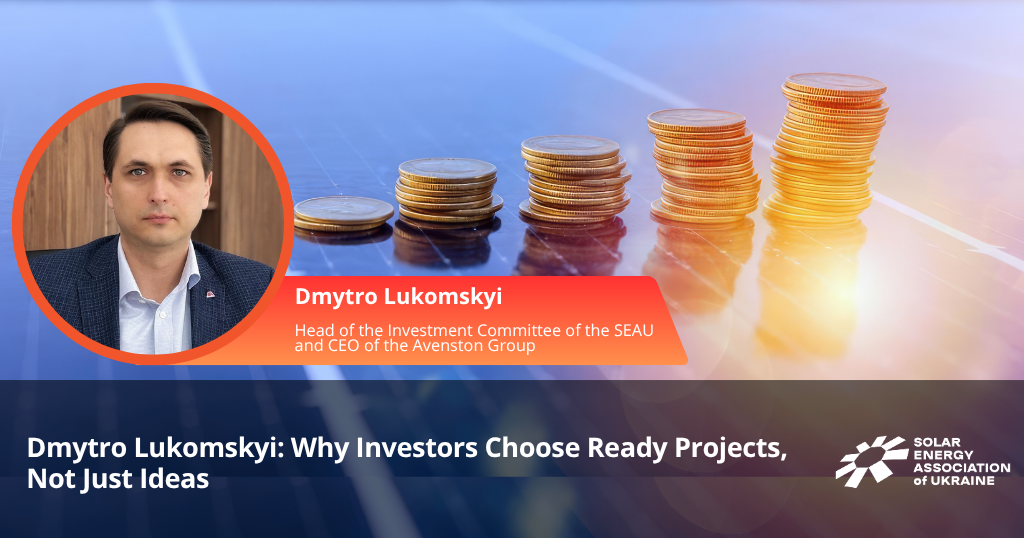
Dmytro Lukomskyi, Head of the Investment Committee of the Solar Energy Association of Ukraine (SEAU) and CEO of the Avenston Group, shares his expert perspective.
Investment-Ready Projects as the New Competitive Advantage of Ukraine’s Renewable Energy Market
Ukraine’s renewable energy sector is undergoing a profound structural transformation. As technologies, financing sources, and business models evolve, so do the criteria by which international investors evaluate projects. Under these conditions, the primary constraint on market growth is increasingly no longer the availability of capital, but rather the shortage of projects that are genuinely ready for investment.
In recent years, interest in the Ukrainian market from international investors, financial institutions, equipment manufacturers, and project developers has grown significantly. However, this interest does not always translate into actual investments.
“Today, investors evaluate not only the project idea itself, but above all its readiness for implementation. The quality of project preparation is increasingly becoming the key factor determining the competitiveness of Ukrainian projects in the international market,” says Dmytro Lukomskyi.
What Does Investment Readiness Mean?
Today, an investment-ready renewable energy project is far more than a land plot with grid connection conditions.
International investors typically assess projects across several key dimensions:
- Legal readiness – properly secured land rights, completed permitting documentation, and predictable regulatory procedures;
- Technical readiness – a realistic project concept, validated technical solutions, and a clear grid connection strategy;
- Financial readiness – a robust financial model with realistic assumptions regarding revenues, costs, and risks;
- Management readiness – the project’s implementation team’s ability to execute the project, manage risks effectively, and bring it successfully into commercial operation.
The alignment of all these elements is what ultimately builds investor confidence.
Project Development: A New Core Competency
The greatest value of a renewable energy project is created long before construction begins. During the development phase, its technical feasibility, economic viability, and investment attractiveness are determined.
“Project development is no longer simply the first stage of implementation. It is becoming a distinct professional competency that increasingly determines a company’s success and its ability to attract international investors,” emphasizes the expert.
A New Market Development Model
Ukraine’s renewable energy sector is gradually transitioning from a model largely driven by government support through the feed-in tariff mechanism to a fully market-oriented environment.
The role of private capital, corporate Power Purchase Agreements (PPAs), battery energy storage systems (BESS), and merchant renewable energy projects without state incentives continues to grow.
This transition is already reflected in market performance. According to the Solar Energy Association of Ukraine, approximately 1.5 GW of new solar PV capacity and more than 1 GWh of battery energy storage systems were commissioned in Ukraine during 2025, bringing the country’s total installed solar capacity to approximately 8.5 GW.
According to Mr. Lukomskyi, these developments significantly increase the requirements for the quality of project preparation.
He believes that in the coming years, Ukraine’s competitive advantage will no longer be determined solely by its ability to build new generating capacity. Instead, the decisive factor will be its ability to systematically develop investment-ready projects that meet the expectations of international investors and financial institutions. Building a strong culture of high-quality project development should therefore become one of the key priorities for the future growth of Ukraine’s renewable energy sector.