
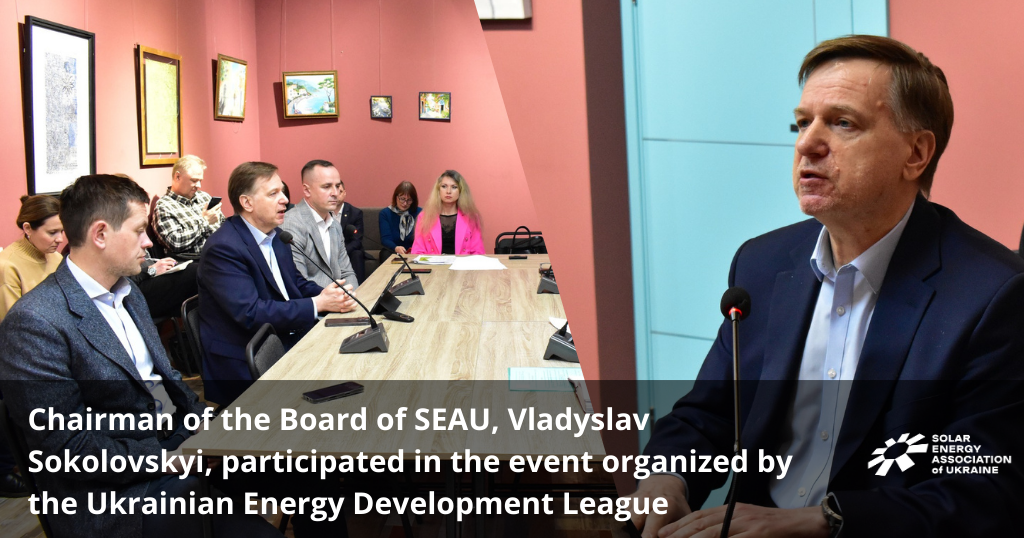
On March 27, the Chairman of the Board of the Solar Energy Association of Ukraine (SEAU), Vladyslav Sokolovskyi, delivered a speech as part of one of the panel discussions at the event “Renewable Energy – A New Wave of Development?”, organized by the Ukrainian Energy Development League.
Among the event’s speakers were:
- Andrii Konechenkov, Chairman of the Board of the Ukrainian Wind Energy Association,
- Artem Nekrasov, Acting Director of the State Enterprise Guaranteed Buyer,
- Kateryna Danylkova, Deputy Director for Prospective Projects at Guaranteed Buyer,
- as well as representatives of industrial renewable energy producers.
The event featured panel discussions on “What hinders and what stimulates the development of green energy in Ukraine today?” and “Mechanisms for supporting renewable energy development: guarantees of origin, quota distribution auctions, etc.”, along with a presentation on the dynamics of renewable energy settlements in the energy market.

During the discussion, Vladyslav Sokolovskyi highlighted key trends in the solar energy sector, focusing on the growth of self-consumption capacity, legislative changes, and the impact of external wartime and market factors on the industry.
According to SEAU estimates, about 800 MW of self-consumption capacity was installed in 2024. This significant increase has had a major impact on enterprise energy supply, particularly during the spring and summer periods. A key factor in this process was the abolition of VAT and import duties on solar panels from July 1, 2023, which significantly eased access to equipment and reduced costs for businesses.
Moreover, the global trend of declining solar panel costs, ongoing for over five years, continues to influence the sector’s development.
SEAU has also recorded growing interest in the installation of solar power plants with energy storage systems (ESS). Some industrial solar plants operating under the market premium mechanism have already started implementing such systems, though large-scale projects have not yet emerged. As Mr. Sokolovskyi noted, the average cost of 1 MW of solar capacity with an ESS today is equivalent to or even lower than the cost of a solar plant without storage five years ago.
“Solar power plants and storage systems must already be built as a single integrated system. The next step is large-scale construction of industrial solar power plants with energy storage. We see strong interest from SEAU members in this opportunity. Calculations indicate that this model can be profitable. We need pioneers to launch such projects. If they succeed, it could trigger a powerful wave of industrial solar + storage development,” emphasized the SEAU Chairman.
A significant step in market development was the introduction of the active consumer status and the adoption of the Green Transition Law. This allows businesses not only to consume electricity for their own needs but also to sell surplus energy to the grid, incentivizing further investment in solar energy.
Another promising mechanism is corporate PPAs (Power Purchase Agreements)—long-term contracts that enable businesses to sell electricity directly to consumers without government involvement.
Additionally, a crucial development was the approval of Law No. 4213-IX, which introduces the concept of cable pooling—allowing multiple generators, such as a solar plant and a wind farm, to be connected at a single grid access point. The National Energy and Utilities Regulatory Commission (NEURC) is currently working on secondary legislation, and SEAU representatives are actively involved in this process.
Another challenge for the sector remains war risk insurance, which remains costly. According to Mr. Sokolovskyi, one potential solution is the creation of a dedicated compensation fund to help insurers lower policy costs.
“If insurance companies reduce the cost of war risk coverage, investors will feel more secure and will invest more in the sector,” he explained.
Mr. Sokolovskyi also emphasized the need for the development of a renewable energy guarantee of origin market and legislative changes allowing guarantees of origin to be counted toward internal CO2 tax payments.
However, the key factor in the growth of Ukraine’s solar energy sector remains stability in the “rules of the game.” The expert reminded that a memorandum between renewable energy producers and the government was signed in 2020 to reduce the green tariff. Its main conditions included timely payments and debt repayment, yet this issue remains unresolved.
“If the government once again unilaterally changes the rules, it will lead to the collapse of private investment not only in solar energy but in the energy sector as a whole,” concluded Mr. Sokolovskyi.
Ukraine has all the prerequisites for the development of solar energy, but clear and predictable conditions for businesses are essential.
Photo: Ukrainian Energy Development League