
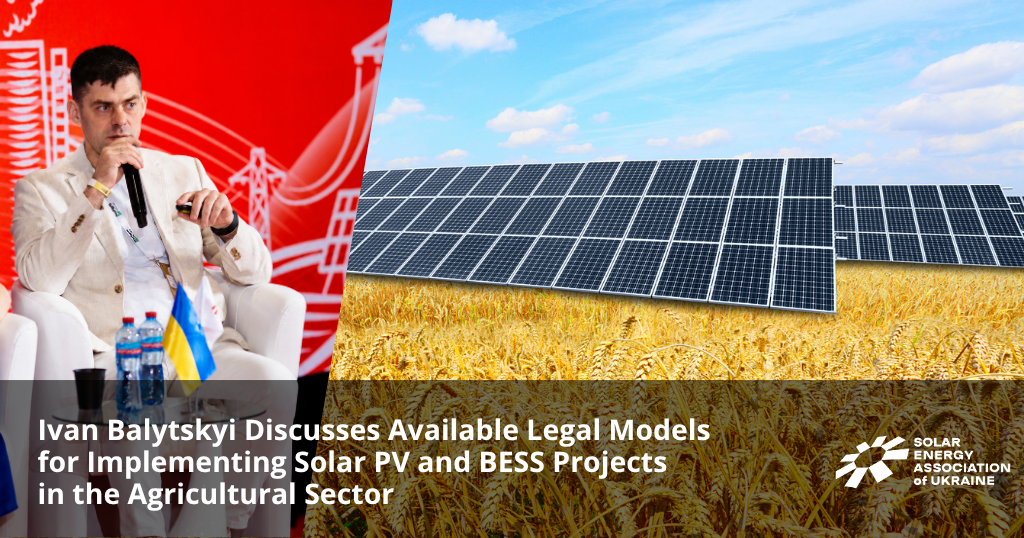
Ukraine’s agricultural sector is increasingly investing in its own power generation and battery energy storage systems. At the same time, the successful implementation of such projects requires not only sound technical solutions but also a clear understanding of the current legal framework and the available business models within the electricity market.
Ivan Balytskyi, Head of the Legal Committee of the Solar Energy Association of Ukraine, outlined the key legal mechanisms currently available to agricultural enterprises for implementing solar power plants (PV) and battery energy storage systems (BESS). He presented the topic during Solar Agro Conference 2026, organized by SEAU.
According to the expert, the current legislation offers agricultural businesses four main models for implementing such projects: self-consumption, self-generation (Net Billing), electricity sales on the wholesale electricity market, and participation in green auctions under the Feed-in Premium mechanism. Each of these models has its own characteristics, advantages, and regulatory requirements.
The simplest option for companies seeking greater energy independence is the self-consumption model. It allows businesses to build a solar power plant solely to meet their own electricity needs without exporting electricity to the grid. Under this mechanism, companies may install PV systems with a capacity of up to 20 MW and battery energy storage systems of up to 5 MW without obtaining electricity generation or storage licenses. Businesses may also become eligible for Guarantees of Origin and participate in aggregated balancing groups to provide balancing services.
The second option is the self-generation (Net Billing) model, which enables businesses not only to cover their own electricity consumption but also to sell surplus electricity to the grid after obtaining the status of an active consumer. Importantly, this model does not require licenses for electricity generation, supply, or storage, significantly simplifying project implementation.
For companies planning to operate as commercial electricity producers, Ukrainian legislation also provides the opportunity to sell electricity on the wholesale electricity market. This model allows participants to trade electricity across various market segments and conclude Corporate Power Purchase Agreements (CPPAs). However, it requires obtaining an electricity generation license, acquiring wholesale market participant status, and assuming responsibility for balancing deviations.
Ivan Balytskyi also paid particular attention to the green auction mechanism, which has operated under the Feed-in Premium model since 2026. He reviewed the auction participation requirements, the duration of state support, project eligibility criteria, and the specific aspects of developing solar power plants combined with battery energy storage systems.
According to the expert, selecting the optimal legal model depends on a company’s development strategy, electricity consumption profile, investment objectives, and willingness to participate actively in the electricity market. Therefore, it is essential to assess all available mechanisms and their legal implications already at the project planning stage.
The Solar Energy Association of Ukraine will continue sharing practical recommendations from industry experts to help businesses better understand legislative developments and successfully implement solar energy and battery energy storage projects.