
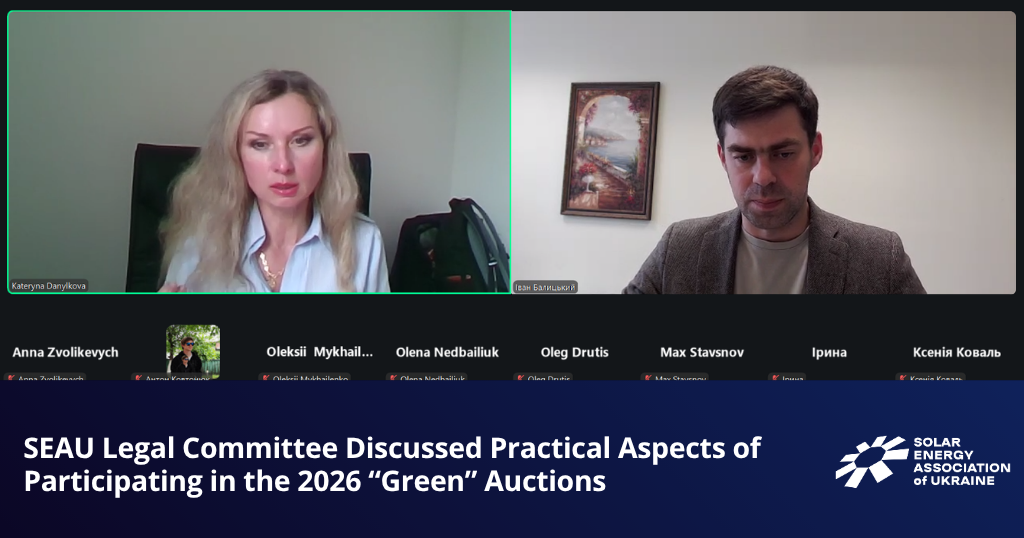
On 9 June 2026, the Solar Energy Association of Ukraine (SEAU) held a closed meeting of the SEAU Legal Committee on the topic: “New Green Auction Rules: How to Receive a Premium from JSC Guaranteed Buyer of up to EUR 120 per MWh.”
The event was held online via Zoom and was attended by SEAU members and regular participants of the Association’s events. The meeting brought together representatives of companies planning to develop new renewable energy projects.
The meeting was moderated by Ivan Balytskyi, Chairman of the SEAU Legal Committee, while the keynote speaker was Kateryna Danylkova, Deputy Director for перспективe Projects at JSC Guaranteed Buyer.
Opening the meeting, Ivan Balytskyi emphasized that the topic of the new green auctions is currently one of the most important issues for investors and market participants:
“Today, we wanted to discuss an extremely important topic for the industry, one that directly affects investment in new energy projects and state support mechanisms.”
A significant part of the meeting was dedicated to a Q&A session. Participants received expert explanations regarding questions submitted during registration as well as those raised during the discussion.
Kateryna Danylkova reviewed the history of the auction model in Ukraine and explained why the full launch of the mechanism had been postponed for several years.
According to the speaker, the original purpose of introducing auctions was to replace the feed-in tariff with a more market-oriented support mechanism. However, the rapid expansion of renewable energy in previous years created additional challenges for the power system.
“The feed-in tariff fulfilled its mission and ensured the rapid development of renewable energy. Therefore, the market is gradually moving to the auction model, which should support further industry growth while taking into account the balancing needs of the power system.”
According to the speaker, compensation payments under the feed-in tariff currently account for approximately 35–45% of Ukrenergo’s transmission tariff, making the search for new support mechanisms particularly important.
Special attention was paid to the results of the first auctions held in 2024 and 2025. Participants analyzed the reasons for limited competition, the specifics of the artificial competition mechanism, and the experience of the first companies participating in the new support system.
One of the key topics was the legislative amendments adopted in 2026.
“Most of the proposals developed following consultations with market participants were taken into account. In particular, the mechanisms for providing financial security for auction participants were diversified.”
Experts reviewed in detail:
- the transition from Contracts for Difference (CfD) to the Feed-in-Premium mechanism;
- extension of auctions until 2034;
- simplified documentation requirements;
- alternative forms of financial security;
- reduced guarantee requirements;
- extended deadlines for fulfilling certain obligations;
- flexibility regarding deviations between installed and declared capacity within acceptable limits.
Particular interest was generated by the new opportunities for Solar + BESS projects.
Kateryna Danylkova presented the new dedicated quota for projects combining solar generation with battery energy storage systems. Such projects may qualify for a maximum support price of EUR 0.12/kWh, significantly higher than the cap established for conventional solar power plants.
The meeting also covered the auction participation process step by step — from studying the regulatory framework and selecting an electronic platform to submitting applications, signing agreements, and fulfilling obligations after winning.
A separate discussion focused on the most common reasons for disqualification, including:
- incomplete or non-compliant documentation;
- submission of inaccurate information;
- exceeding the maximum bid price;
- violations related to ownership structure requirements;
- repeated participation following refusal to sign documents after previous auctions;
- non-compliance of BESS technical parameters with established requirements.
Company representatives raised numerous practical questions regarding minimum project capacity, bank guarantees, grid connection procedures, contractual obligations, and technical requirements for Solar + BESS projects.
Summing up the meeting, Ivan Balytskyi stated:
“For SEAU, it is important not only to inform the market about legislative changes, but also to provide a platform where businesses can receive answers directly from those who develop and implement these mechanisms. We will continue organizing Legal Committee meetings to address the issues that matter most to market participants.”
The Solar Energy Association of Ukraine expresses its gratitude to the experts – Ivan Balytskyi and Kateryna Danylkova – for the professional and substantive discussion.
SEAU would also like to remind its members that recordings of meetings and webinars held on the Association’s platform are available upon request.